What Are Fire Bricks Made Of? From Raw Materials to Fired Properties
Jason Gong
Founder & Sales Director · 10+ Years in Refractory
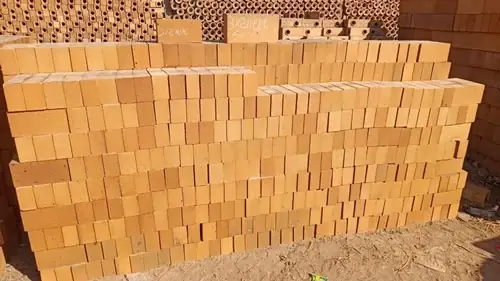
Fire bricks are made from heat-resistant mineral systems—not one universal recipe. Traditional fireclay brick commonly combines aluminosilicate clays with pre-fired aggregate called grog. Other refractory bricks may use higher-purity alumina sources, silica, magnesia, carbon or engineered pore formers. Chemistry sets the material family; particle sizing, mixing, forming, drying, firing or tempering, and quality control create the finished structure and properties.
“Fire brick” describes a job, not one recipe
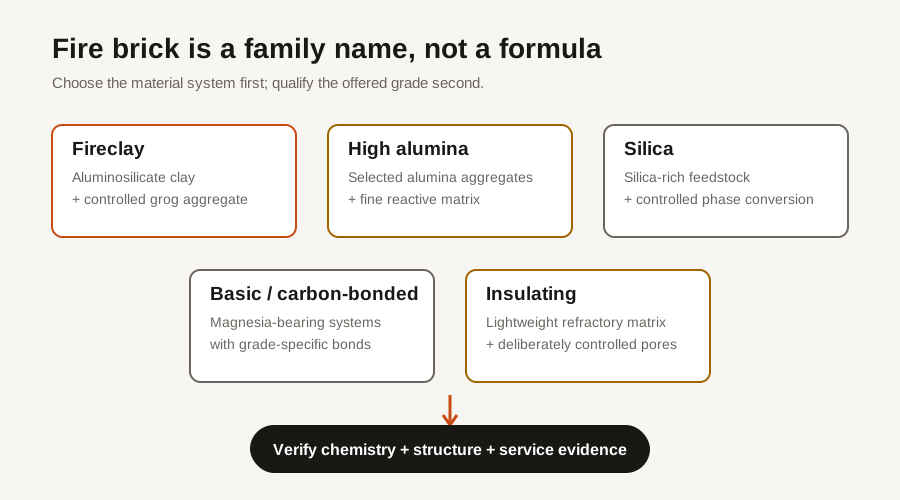
People often use fire brick for any brick that works near heat. In technical purchasing, that label is too broad. ASTM lists separate classifications for fireclay and high-alumina brick, insulating firebrick, silica brick, magnesia-containing brick, mullite refractories and other families. Its current refractory standards directory also separates classification standards from test methods for density, porosity, strength, reheat change, thermal expansion and thermal conductivity.
That distinction matters because two bricks can look similar while relying on different mineral phases, pore structures and bonds. The general refractory-brick guide owns the broad type-and-application overview. This article answers the narrower composition question: what goes into a brick, what manufacturing changes, and what evidence should follow the product to a buyer.
The main raw-material families
Fireclay bodies: clay plus controlled aggregate
Traditional fireclay brick is an aluminosilicate ceramic. A classic US Bureau of Standards manufacturing reference describes fireclay bodies made from combinations of plastic clay, flint or semiflint clay, and grog—pre-burned material used like aggregate in concrete. The historical document is useful for the process principle, not as a modern purchasing specification: exact proportions and firing conditions vary by grade and producer.
Plastic clay helps the batch form and bind before firing. Flint clay or other non-plastic refractory clay contributes the refractory skeleton. Grog reduces the amount of raw clay that still has to shrink during drying and firing. Its grading also changes packing and the finished structure. Reclaimed refractory can be a valid feedstock only when it is identified, cleaned, processed and quality-controlled; random crushed scrap is not a specification.
High-alumina bodies: selected aggregates plus a fine matrix
High-alumina brick may use calcined bauxite, andalusite, mullite, tabular alumina, fused alumina, calcined alumina and other selected sources. Coarse fractions form the aggregate skeleton; fine particles fill the matrix and help develop bonding during heat treatment. Almatis’ refractory raw-material guide explains that aggregate size fractions and fine calcined or reactive aluminas serve different formulation roles.
Alumina content is useful, but it is not the whole grade. ASTM C27 classifies high-alumina brick primarily by alumina content while noting that alumina-silica bricks span a wide chemical range. Impurities and mineral phases still matter. A buyer should therefore compare a current product data sheet and certificate of analysis, not infer performance from an “alumina percentage” in isolation.
Silica and basic bricks: different chemistry, different evidence
Silica brick is built around silica-rich raw material and controlled mineral conversion. Magnesia, magnesia-carbon and related basic bricks use magnesia-bearing raw materials and may use carbon and resin-bond systems rather than a conventional fired ceramic bond. These are not simply “stronger fireclay bricks.” Their chemistry, bonding, thermal behavior and compatible process environments differ.
For silica-specific phase and cycling questions, use the silica fire brick guide. Application or zone selection still belongs with the relevant furnace or industry owner.
Insulating firebrick: pores are part of the design
Insulating firebrick uses a deliberately lightweight, porous structure. The raw batch and manufacturing route are chosen to create and control those pores because density and pore structure strongly affect heat transfer and stored heat. The tradeoff is that a lightweight insulating grade should not be treated as a dense abrasion- or load-bearing brick without design evidence. See the insulation brick product family when the commercial decision is thermal backup or lightweight lining.
What each ingredient is doing
| Batch element | Primary role | Evidence to request |
|---|---|---|
| Refractory aggregate | Provides the coarse mineral skeleton and dimensional stability | Source/type, chemistry, grading and impurity limits |
| Fine matrix | Fills spaces, adjusts chemistry and participates in bonding or sintering | Particle-size distribution, mineral/chemical limits and batch control |
| Plastic clay or temporary binder | Provides green workability and strength before heat treatment | Binder system, drying controls and residue/impurity limits |
| Pore former | Creates controlled porosity in insulating products | Target density, pore-related test data and burnout control |
| Additive or mineralizer | Adjusts phase formation, processing or bonding | Approved formulation range and finished-product verification |
| Qualified recycled material | Replaces part of virgin feedstock after controlled recovery | Origin, sorting, cleaning, chemistry and lot-quality plan |
The formulation is a system. Changing one raw material can alter drying shrinkage, firing behavior, mineral phases, pore structure and compatibility. This is why a generic internet recipe cannot establish a commercial brick grade.
How raw materials become a finished brick
The broad manufacturing chain is consistent even though equipment and setpoints vary by product. A US government characterization of fireclay-brick production describes grinding and sizing the clay, mixing, die pressing or extrusion, drying, and kiln firing. Modern shaped refractories may also be hydraulically or isostatically pressed, resin-bonded and tempered, or fired to create a ceramic bond.
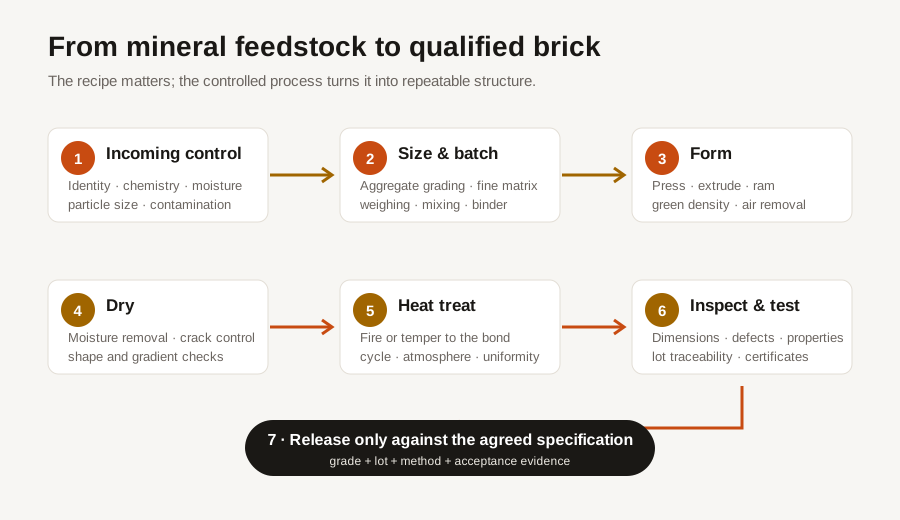
- Incoming-material control: identify the mineral source, chemistry, moisture, particle size and contamination risks.
- Crushing, grinding and sizing: prepare coarse aggregate and fine matrix fractions for the target packing and texture.
- Batching and mixing: weigh the approved formulation and distribute water, binder and additives consistently.
- Forming: press, extrude, ram or otherwise shape the green brick. Forming pressure and air removal influence density gradients and defects.
- Drying: remove process moisture without cracking, warping or trapping damaging gradients.
- Firing or tempering: develop the intended ceramic or carbon-bond system under a controlled thermal and atmospheric cycle.
- Sorting and testing: check dimensions, visual defects and the properties required by the grade specification.
Almatis’ dense shaped refractory overview states the core relationship directly: the raw-material mixture, compaction method and heat treatment define the properties of a shaped refractory. A modern RHI Magnesita production study also shows why one laboratory composition is not enough; formulations were pressed, fired and tested for chemical, physical and thermomechanical behavior before industrial production trials.
Firing turns a recipe into a microstructure
Chemistry tells you which reactions and phases are possible. Manufacturing determines how much of that potential becomes a useful brick. Particle packing, compaction and heat treatment influence pore size and connectivity, bonding between grains, phase development, dimensional change, strength and thermal behavior.
The result is not a single “quality” number. A denser structure may improve strength or resistance to penetration in one duty while changing thermal conductivity or thermal-cycle behavior. A highly porous structure can lower heat transfer but reduce mechanical capacity. Those tradeoffs must be matched to the furnace zone and lining design.
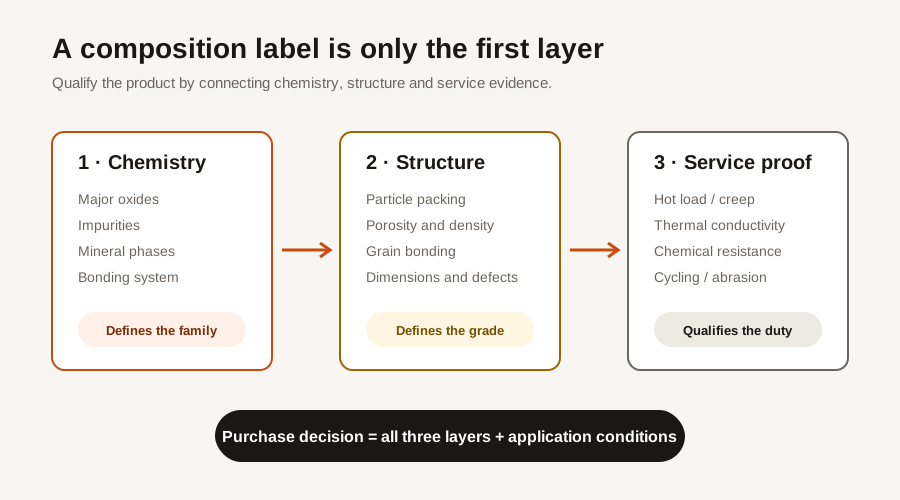
Read the data sheet as a connected evidence set
| Data field | Useful for | Does not prove by itself |
|---|---|---|
| Chemical analysis | Material family, major constituents and impurity screening | Finished pore structure, cycling response or service life |
| Apparent porosity and bulk density | Comparing structure within the same product context | Corrosion resistance or insulation performance alone |
| Cold crushing strength | Handling and cold mechanical comparison | Hot-load, creep, thermal shock or abrasion behavior |
| Permanent linear/reheat change | Dimensional stability after a defined heat exposure | A universal safe operating temperature |
| Refractoriness under load or creep | Hot deformation under a stated load and method | Chemical compatibility with a process slag or vapor |
| Thermal conductivity | Heat-flow calculation at stated temperatures and method | Strength, hot-face suitability or total lining loss |
| Dimensions and tolerances | Joint control, fit and quantity planning | Material identity or correct installation |
ASTM’s directory lists C20 for apparent porosity and bulk density of burned brick, C134 for dimensions and density, C113 for reheat change, and separate methods for thermal conductivity and hot-load properties. The method and test condition belong with the number. A thermal-conductivity value without temperature, units and method is incomplete; a strength value without specimen and test context is similarly weak evidence.
What composition cannot tell you
- Colour is not chemistry. Firing atmosphere, impurities and surface condition can change appearance.
- One oxide percentage is not a grade approval. Mineral phases, impurities, bond and structure can differ.
- A maximum-temperature label is not a lining design. Load, atmosphere, cycling, gradients and chemical contact still govern selection.
- Cold strength is not hot performance. Use the property that matches the failure mechanism.
- A sample is not a production-lot guarantee. Define sampling, acceptance, traceability and certificate requirements.
- A product data sheet is not a service-life promise. Installation and operation remain part of the system.
Build a quote brief that can be checked
Before requesting a quote, send enough information for a supplier to rule a grade in or out:
- equipment, furnace zone and lining function;
- normal, peak and upset temperature conditions;
- atmosphere plus slag, ash, vapor, metal or batch chemistry that contacts the brick;
- heating/cooling frequency and known thermal gradients;
- mechanical load, abrasion, impact or gas velocity;
- brick shape, dimensions, tolerances, drawing and quantity;
- required standard/classification and test methods;
- current material, observed failure and any post-service analysis;
- certificate, sample and lot-acceptance requirements.
Start at the Firebrics product catalog to identify a plausible family. Use the high-alumina brick page or insulation brick page only as a commercial starting point; the project conditions and current grade evidence still control the final selection.
Turn the material question into a checkable brick specification
A draft quote is not application approval; final selection should reference the agreed grade, data sheet, lot evidence and lining design.
Sources and further reading
- ASTM International — Refractory Standards
- US Bureau of Standards — Fire-Clay Brick: Manufacture, Properties, Uses and Specifications
- Almatis — Dense Shaped Refractory
- Almatis — Aluminas for Refractories
- RHI Magnesita — Circular Raw Material in Magnesia-Chromite Bricks