Refractory Slag-Corrosion Tests: Match Chemistry and Method Before Comparing Results
Jason Gong
Founder & Sales Director · 10+ Years in Refractory
A refractory slag corrosion test supports a bounded comparison only when the reports disclose compatible slag chemistry and history, specimen preparation, exposure method, conditions and measurement definitions. A smaller reported loss is not enough to establish that one material is better for the contacting slag in a vessel. First check what was exposed to what, how the exposure changed, and what the result actually measures; then identify the parts of the application that the laboratory did not represent.
The 2020 review by Reynaert, Śnieżek and Szczerba describes why test context matters, including the differences between static and dynamic methods and between dissolution and infiltration. The worksheet below turns those distinctions into a buyer's report review. It is an evidence checklist, not a material acceptance standard, a test procedure or a prediction of campaign life.
Separate chemical corrosion from mechanical wear
Chemical corrosion and mechanical wear answer different questions, even when they act together. In the 2004 review on direct and indirect slag corrosion, chemical attack includes reaction or dissolution involving the refractory and the liquid slag; physical or mechanical wear includes erosion and abrasion. The review also recognizes combined action. A slag-corrosion report therefore needs its stated scope before it can be used as evidence about wear.
For a buyer, the practical distinction is between a report that examines chemical interaction with a specified contacting medium and a claim about the complete wear duty of a lining. Ask which interaction the exposure was designed to investigate and which observation supports the conclusion. Do not treat the word “resistance” as a common measurement across otherwise different tests. This conceptual distinction does not diagnose a damaged lining from a photograph or identify the cause of a plant failure.
Check the slag source and its history during exposure
The initial slag analysis is only the starting point for judging representation. The 2004 review explains that oxidation, preferential penetration of constituents and dissolution of refractory into slag can change the medium during a test. The 2020 review likewise discusses the limits associated with slag changes and saturation. A report should therefore connect the chemistry to the actual sample used and disclose what happened to that medium during exposure.
Keep three pieces of information together: where the sample came from, how it was prepared, and the available chemical analysis. Then ask whether the same slag remained in contact throughout the exposure or whether it was renewed. A prepared test slag and a sample taken from an application need their respective origins stated; an apparently similar analysis does not resolve an undisclosed preparation or exposure history.
Use this short evidence checklist when a report describes its medium only as “slag”:
- Identify the sample source and the preparation recorded for the test.
- Attach the available analysis and identify the sample it describes.
- Obtain the disclosed changes to the medium and the renewal arrangement during exposure.
- Record what remains unknown about the relationship between the test medium and the contacting application slag.
These are questions for the evidence packet, not a universal plant sampling protocol or a prescribed slag recipe. If the source or renewal history is missing, leave representation unresolved. Replacing that gap with an acid/basic label would promise more than the evidence establishes.
Compare the actual static or dynamic exposure
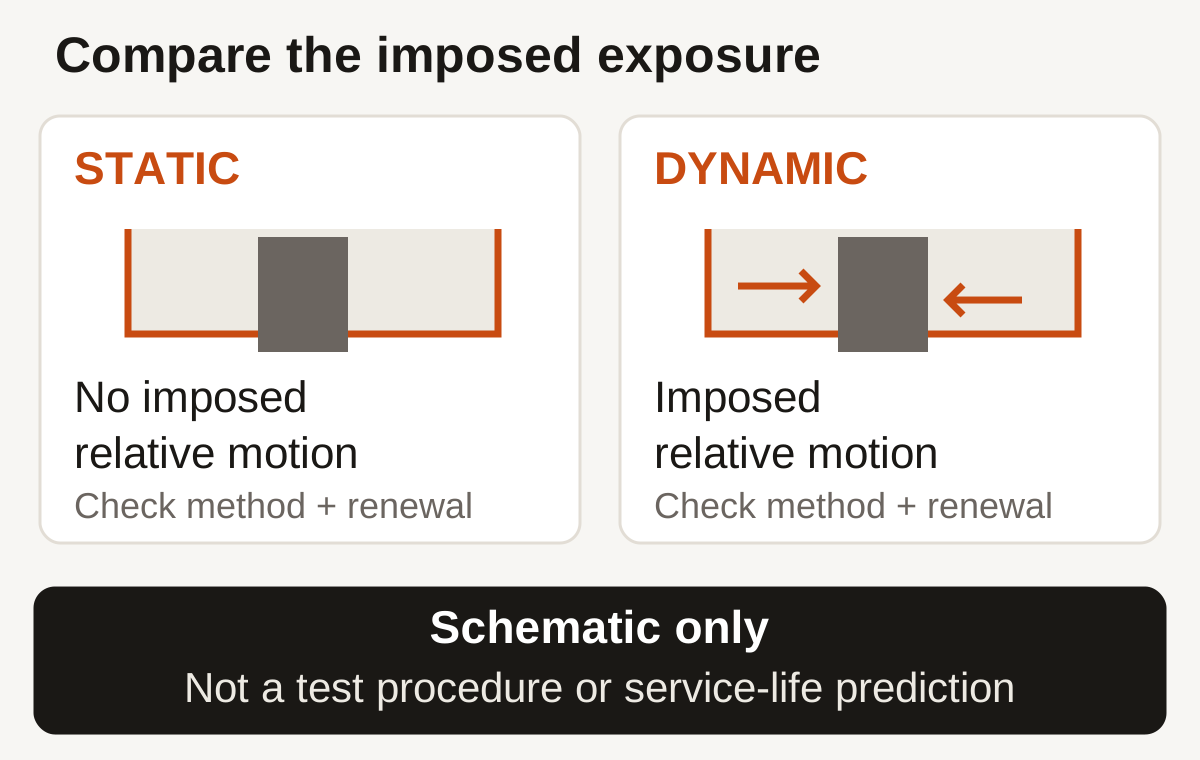
Static and dynamic exposures should be distinguished by the relative motion they deliberately impose, not by a result label alone. The historical reviews describe static cup or immersion tests without deliberately imposed motion between the liquid and the refractory, while dynamic methods introduce motion of the liquid or specimen. “Static” does not mean that every phenomenon inside the melt is motionless; it describes the test's imposed exposure arrangement.
That distinction matters alongside renewal. The 2004 review identifies saturation of a static contacting medium with reaction products as a limitation when the application instead exposes refractory to moving, refreshed slag. A dynamic method does not automatically resolve every representation problem, either. Ask what moves relative to what, whether the medium is renewed, and which specimen arrangement the report actually used. Neither method label is a universal ranking of test quality.
The Orton refractory test listing identifies rotary slag testing under ASTM C874 and describes comparison in a rotating furnace. This is a public laboratory scope description, not access to the full controlled standard or verification of its current edition. It does not establish a Firebrics testing capability or a mandatory procedure for the buyer's application. A laboratory report should identify its actual method, cited edition and deviations rather than relying on a service-listing name.
Keep temperature, time and atmosphere with the result
A result needs its actual exposure conditions beside it. Jansson and colleagues' 2004 rotating-specimen study reports temperature, immersion duration, imposed rotation and atmosphere as part of its experimental setup. The value for this review is the disclosed context, not a set of settings to copy into another test.
Read each report's declared temperature, exposure duration, atmosphere and motion before comparing its endpoint. If the conditions differ, preserve the difference in the matrix rather than treating the reports as a method-matched pair. If a setting is absent, ask the reporting laboratory to supply it or explain the limitation. The same named method does not by itself fill in the missing conditions.
The cited study and reviews are historical technical literature. They support these comparison questions but do not establish a current mandatory numerical recipe, acceptance threshold or compliance claim. This article supplies no recommended furnace temperature, exposure time, gas setting or rotation speed. Those details belong to the actual applicable method and the reporting laboratory's documentation.
Read corrosion loss and penetration as separate measurements
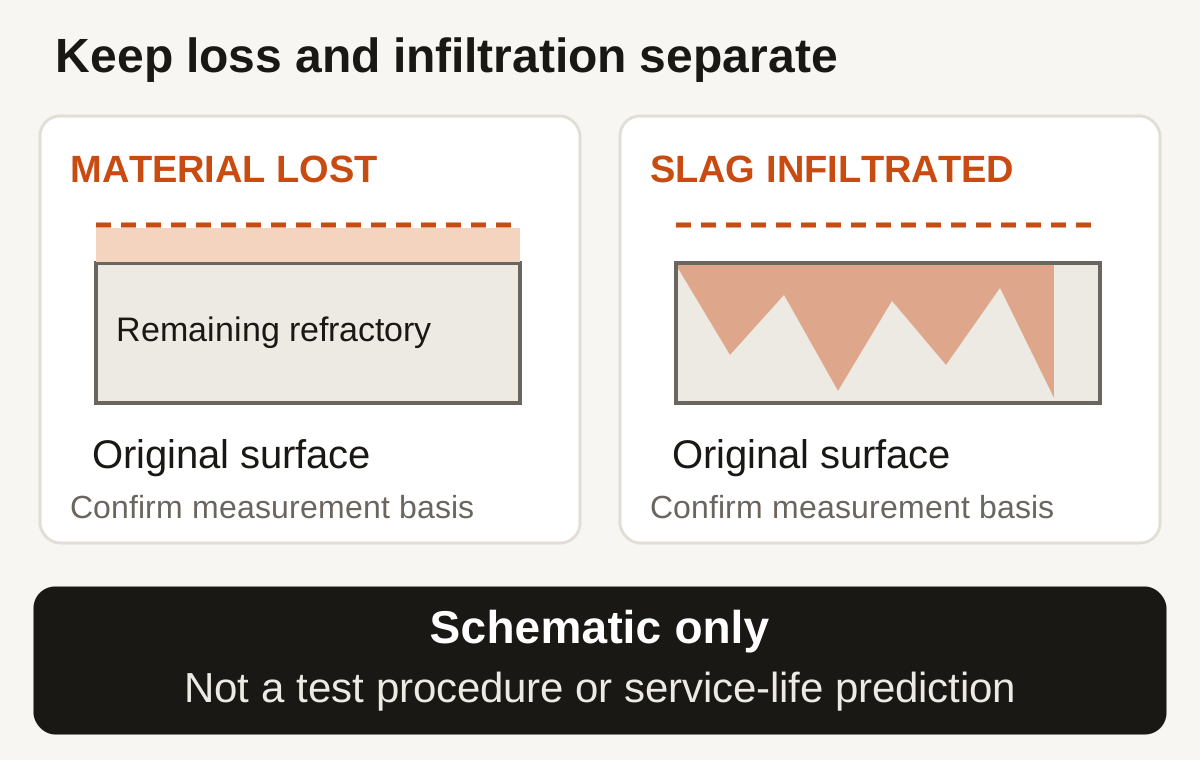
Material removed by dissolution and slag infiltrating into remaining refractory are different observations. The 2020 review reports separate loss and infiltration indexes and, in its Figure 11 discussion, distinguishes greatest dissolution depth from average infiltration depth. Those are source-specific reporting examples, not a universal formula or a shared definition for every laboratory.
Before interpreting a reported “corrosion depth,” obtain the boundary being measured, the location, the units and the aggregation basis. A depth cannot be read as an area or volume percentage, and a greatest depth cannot simply be compared with an average. Even two values printed with the same unit need their definitions checked: matching units alone does not tell the buyer whether the observations describe the same endpoint.
| Reported endpoint | Definition to obtain | Comparison caution |
|---|---|---|
| Dissolution or loss | What material loss is measured, from which reference boundary and at which location? | Keep loss separate from slag penetration into the remaining refractory. |
| Penetration or infiltration | What infiltrated region is identified, and how is its boundary recorded? | An infiltration observation is not interchangeable with material removed. |
| Depth versus area or volume | What geometric quantity, units and reference basis define the result? | Do not equate a depth with an area or volume percentage. |
| Maximum versus average | Which locations contribute, and is the reported quantity greatest or averaged? | Do not compare a maximum directly with an average as though they share a basis. |
The table is a guide to questions, not a conversion tool. When a report uses an index, request its actual definition instead of assuming that another laboratory's similarly named index means the same thing. Keep loss and infiltration as separate entries wherever the report measures both.
Build a method-matched report comparison matrix
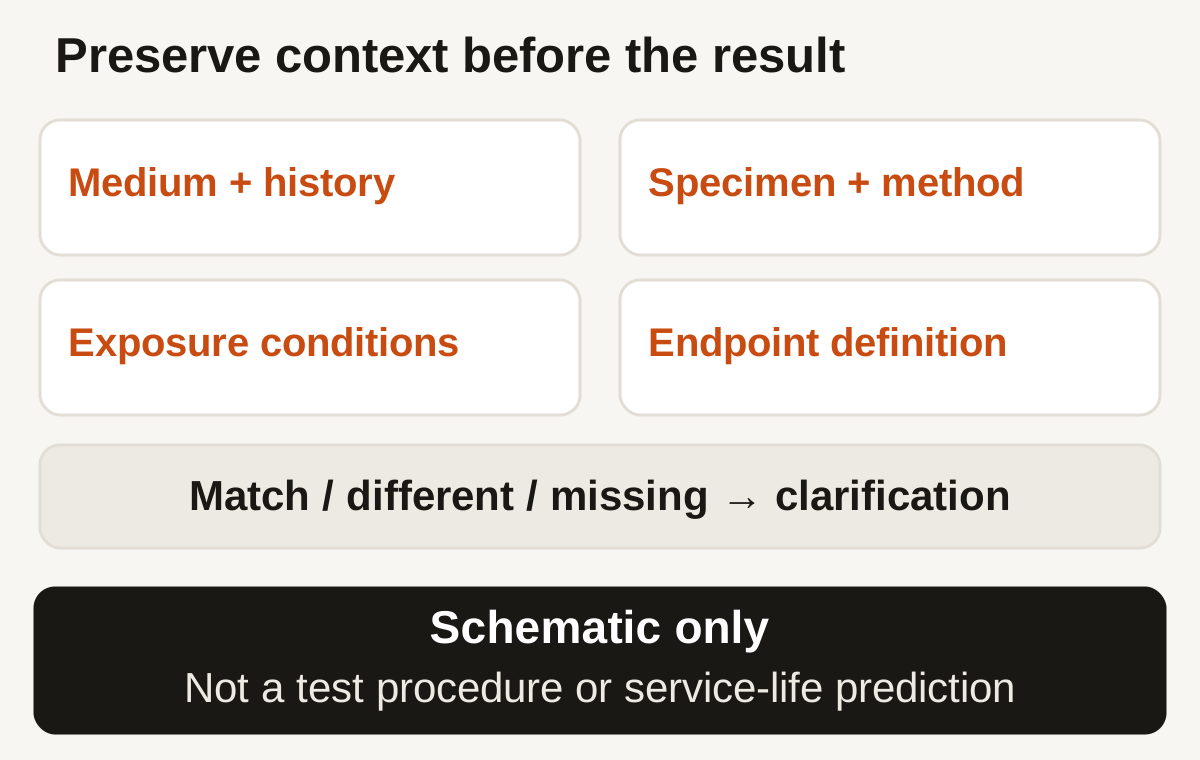
Compare the report fields before comparing the results. The following original worksheet synthesizes the method and reporting limits discussed in the 2004 and 2020 reviews. It keeps contacting-medium history, specimen context and endpoint definitions visible alongside exposure conditions. It contains no supplier data and does not award a material a pass or a ranking.
Start with the two actual reports. Copy each field independently, preserving the report's wording and units. In the final column, mark a field “match,” “different” or “missing,” with a note explaining the basis. The placeholders below are deliberately unfilled: neither a blank field nor an unreported condition should be interpreted as a match.
| Comparison field | Report A | Report B | Match / different / missing |
|---|---|---|---|
| Slag source, preparation and available chemistry | To complete from report | To complete from report | To assess; explain basis |
| Slag changes and renewal during exposure | To complete from report | To complete from report | To assess; explain basis |
| Refractory identity, preparation and specimen geometry | To complete from report | To complete from report | To assess; explain basis |
| Actual method, cited edition and deviations | To complete from report | To complete from report | To assess; explain basis |
| Temperature and exposure duration | To complete from report | To complete from report | To assess; explain basis |
| Atmosphere and relative motion | To complete from report | To complete from report | To assess; explain basis |
| Measured quantity, location, units and aggregation | To complete from report | To complete from report | To assess; explain basis |
| Unresolved application representation | To complete from report | To complete from report | To assess; explain basis |
Turn missing fields and materially different bases into a separate clarification list for the reporting laboratory. For example, a declared greatest dissolution depth in one report and an unspecified “corrosion” value in the other leave the measurement comparison unresolved; no numerical example is needed to expose that gap. Ask for the definition before interpreting a difference.
Once the disclosed fields support a compatible basis, describe any comparison within that stated method and those conditions. Preserve the remaining application limitations separately. A completed worksheet documents what is known and missing; it is not proof that two tests are equivalent or that either test reproduces a vessel.
Keep laboratory results within their vessel limits
Laboratory comparability and application representation are separate judgments. The historical reviews identify transfer limitations involving slag saturation and renewal, relative motion, specimen geometry and thermal gradients. In particular, the 2004 review explains that an isothermal specimen does not reproduce the hot-face-to-cold-face gradient of a commercial lining. A useful comparative result can therefore remain limited as evidence for a vessel.
After completing the matrix, write an application-gap note addressing the contacting slag and its renewal, the relevant motion, the specimen-versus-vessel geometry, and the thermal-gradient context that the test represents or omits. Mark unsupported representation as unresolved instead of translating a laboratory endpoint into campaign life or a wear rate. Matching chemistry and method controls the comparison; it does not grant whole-vessel suitability.
For broader application context, see the existing guide to refractory bricks for steel-industry applications. Keep that application discussion separate from this report review. The link does not supply the missing laboratory definitions, validate a particular grade against a slag, or extend a test result into a service-life claim.
Prepare a slag sample and test-evidence brief
The next useful output is a brief that makes the evidence gaps answerable. Assemble the sample context and report definitions in one packet, using the matrix to distinguish recorded information from open questions. The checklist below is an original buyer/laboratory conversation aid derived from the cited reviews, not a laboratory procedure or a Firebrics testing service.
- Contacting medium: identify the slag sample source, preparation and available analysis; record what is known about changes and renewal during the test.
- Refractory specimen: include the material identity, preparation and specimen geometry stated in the report.
- Exposure: attach the actual method and cited edition, deviations, temperature, duration, atmosphere, relative motion and medium-renewal information.
- Measured endpoint: obtain the definitions for loss and infiltration, the measured locations, units, geometric basis and maximum or average reporting.
- Application gap: describe the intended component and service context, identifying what the laboratory exposure has not represented.
- Clarification request: list the missing or materially different fields and ask the reporting laboratory what further information is needed to interpret them.
Send test-definition questions to the reporting laboratory. For a separate product inquiry, the high alumina brick product information provides the existing family-level destination. Opening that page does not mean an offered grade has been tested against the slag or is suitable for the application. Keep the available test evidence and the unanswered laboratory questions attached to the product requirements.
References & Further Reading:
The technical literature below is historical and is used for bounded method and report interpretation. No current controlled standard edition or full procedure has been verified here; the public laboratory listing is a scope description.
- Direct and Indirect Slag Corrosion of Oxide and Oxide-C Refractories, 2004: chemical/mechanical distinctions, contacting-medium changes, test arrangements and laboratory limitations.
- Corrosion Tests for Refractory Materials Intended for the Steel Industry — A Review, 2020: static/dynamic test context and distinct loss/infiltration reporting.
- Jansson and colleagues' rotating-specimen study, 2004: an example of explicitly documented exposure conditions, not recommended settings.
- Orton refractory test listing: public rotary slag-testing service scope, not a substitute for the applicable controlled method.