Permanent Linear Change of Refractory Brick: Read Reheat Reports Correctly
Jason Gong
Founder & Sales Director · 10+ Years in Refractory
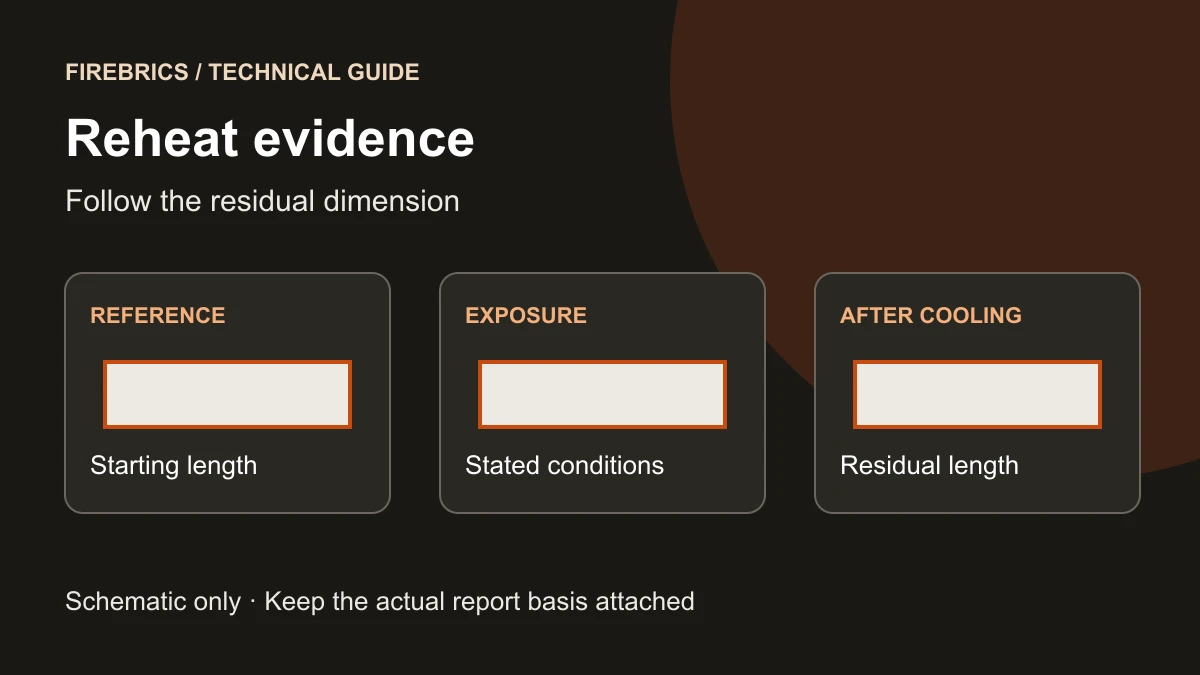
Permanent linear change (PLC) describes the residual expansion or contraction left after a stated heating exposure and cooling, rather than the brick's length while it is hot. Read the result together with its reference dimension, sign convention, measurement basis, material and specimen identity, cited method, heating schedule, holding time, and preparation. Two percentages are comparable only after those bases have been checked. A reheat result alone does not supply reversible thermal expansion, an operating-temperature joint allowance, or a service-life guarantee.
Read PLC as a residual dimension after cooling
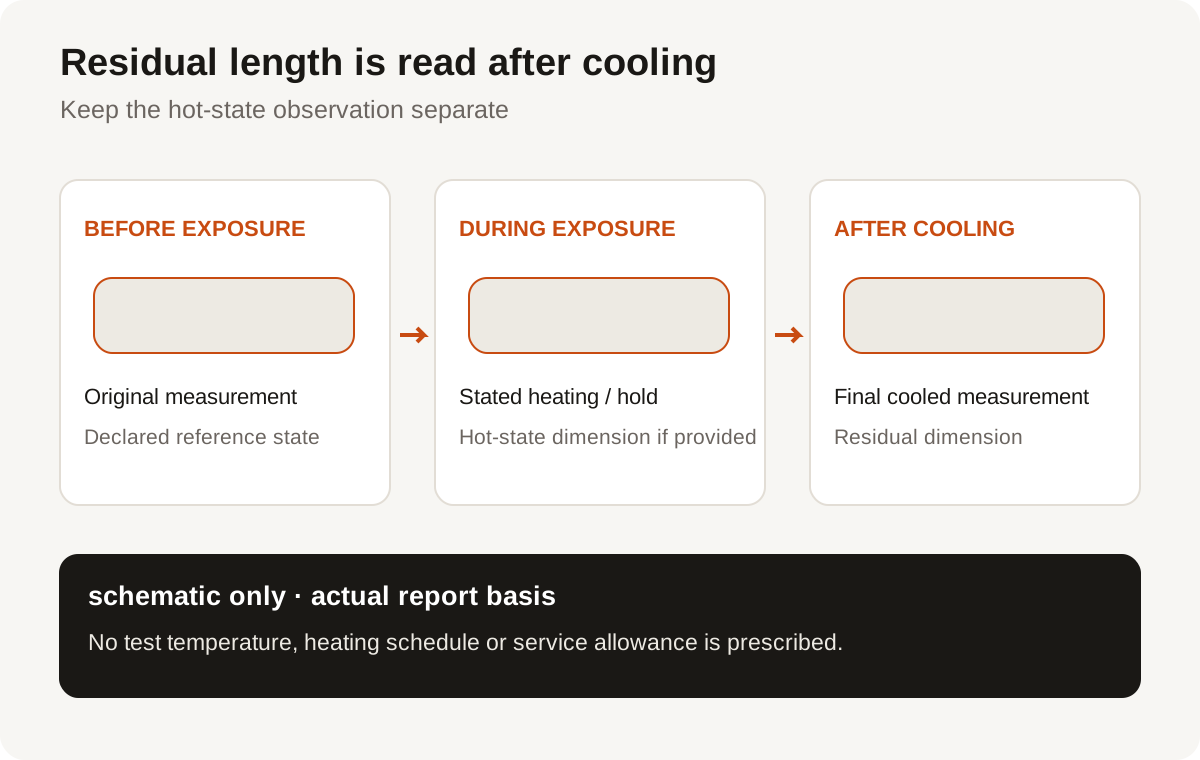
A reheat report asks what dimension remains after the test exposure and cooling. Its starting measurement and final measurement bookend the exposure. The hot-state dimension is a different observation, taken at a different point in that sequence.
The retrieved historical IS 1528 Part 6:2010 definition describes expansion or contraction remaining after a specified temperature, specified time, and cooling to ambient. A commercial refractory glossary gives the same residual distinction. This establishes the meaning used here; it does not establish one cooling temperature or measurement procedure for every method.
When a datasheet gives a PLC percentage beside a temperature, ask what exposure and final measurement that label represents. Keep the reported condition attached to the number. Do not relabel it as expansion at operating temperature.
Keep the original length and sign attached to the result
A percentage needs a denominator and a direction. Read which dimension supplies the reference, how the before-and-after measurements were obtained, and what positive and negative values mean in the submitted report. Retain the sign exactly as reported until its meaning is clear.
The historical IS text expresses relevant length change as a percentage of the original length and reports an increase as positive and a decrease as negative. That is a documented historical example of a convention, not proof that every C113, EN, or ISO report uses one identical formula or sign presentation.
A sheet that says only “shrinkage 0.4%” has not given the same presentation as a signed result. Record both the label and the convention before transferring the value into a comparison. If the initial and final dimensions are supplied, check the arithmetic on that declared basis; if they are absent, ask for the measurement basis instead of reconstructing it from a product's nominal size.
Compare the stated exposure and preparation
Temperature and holding time belong to the reheat result, along with the heating schedule and the specimen's state before the initial measurement. An as-received dimension, a dimension after preparation, and a dimension following an earlier heat treatment must not be silently treated as the same starting point.
ASTM's public C113 scope covers permanent linear change of refractory brick heated under prescribed conditions. Its public significance section also warns that samples should represent the product and the selected schedule should be appropriate to it. The full controlled method has not been read for this guide, so no prescribed numerical schedule is reproduced here.
For a buyer comparison, transcribe what each actual report declares: preparation or drying, prior firing or conditioning when recorded, initial measurement state, temperature program, actual holding time, and final measurement condition. Mark an absent field as missing. Do not replace it with a customary value or assume that two matching maximum-temperature labels prove the rest of the exposure matched.
Identify the material, specimen and cited method
“Reheat change” does not erase material and method differences. Orton's laboratory service list separately names ASTM C113 for refractory brick, C210 for insulating firebrick, and C179 for refractory plastic and ramming-mix specimens. ASTM's public C113 scope likewise points to additional provisions for specific materials.
Those listings support a method-family distinction. They are not enough to select a controlled procedure for a particular purchase or certify compliance. Read the exact method and edition cited by the actual report, the product or material description, the batch when available, and the specimen or measurement direction. Send an unclear applicability question to the laboratory or responsible technical reviewer.
For broader material context, the existing fire brick composition and property guide covers constituents and property labels. This article stays with residual reheat evidence, rather than recommending a composition, prescribing first firing, or selecting a forge lining.
Check whether the report measured length or volume
Before comparing the percentages, identify the measured quantity. Was the result based on a direct length measurement, a volume measurement, or a method-specific calculation derived from that measurement? Keep that basis visible beside the result.
This distinction is present in the retrieved sources. Orton lists volume change separately in its C113 service description. The historical IS text also uses different measurement bases for its insulating and dense shaped product cases. That historical calculation cannot be imported into another method as a universal rule.
A single measured length does not establish what happened along the other axes or to the specimen's volume. Do not multiply a one-axis percentage by three, divide a volume percentage by three, or assume uniform change merely to make two reports appear comparable. If their bases differ, retain the distinction and request the underlying measurement and calculation details.
Follow an explicitly hypothetical before-and-after example
The following values are assumed for illustration. They are not Firebrics data, supplier test results, required measurement precision, or an acceptance limit. The example uses a direct length measurement and defines its own convention: an increase is positive, a decrease is negative, and the original length is the denominator.
Under that stated convention:
Illustrative percentage change = 100 × (length after cooling − original length) / original length.
| Assumed original length | Assumed length after cooling | Signed difference | Illustrative percentage | Meaning under this convention |
|---|---|---|---|---|
| 100.0 mm | 99.6 mm | −0.4 mm | −0.4% | Residual shortening |
| 100.0 mm | 100.4 mm | +0.4 mm | +0.4% | Residual lengthening |
For the first row, the calculation is 100 × (99.6 − 100.0) / 100.0 = −0.4%. The second gives 100 × (100.4 − 100.0) / 100.0 = +0.4%. Both use the same assumed reference and sign convention, so the direction can be read transparently.
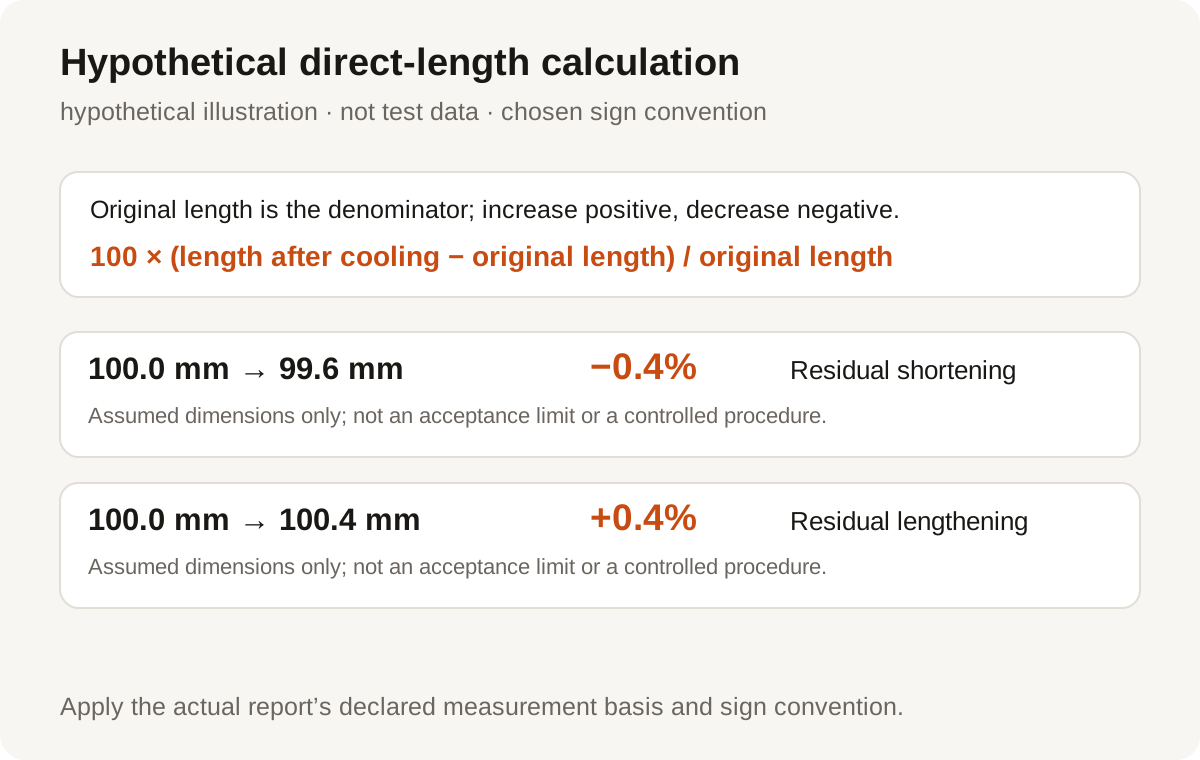
These rows show how to read an explicitly defined direct-length calculation. They do not prove which report is acceptable or which brick should be purchased. Apply the submitted report's own method, measurement basis, and stated convention when checking its actual result.
Separate residual change from reversible hot expansion
Residual dimensional change concerns what remains after cooling. Reversible thermal expansion concerns the dimension that changes with temperature and returns as temperature returns. A cooled residual measurement does not record the whole hot-state dimensional path.
For report reading, keep separate spaces for the starting dimension, any hot-state measurement actually provided, and the final dimension after cooling. This bookkeeping prevents a residual PLC value from being used as though it described total movement while the lining is hot.
PLC evidence alone therefore cannot supply a thermal-expansion coefficient, joint allowance, or installation movement design. Nor does one reheat exposure establish stability over every operating cycle. Those decisions require the applicable engineering basis and additional evidence; this guide supplies no calculation or guarantee for them.
Use a reheat-report comparison checklist
Start with the context columns before ranking the result column. The worksheet below is an original buyer reading aid grounded in the retrieved scope and reporting context. It is not a list of mandatory clauses common to all standards.
| Field to preserve | Report A | Report B | Comparison state | Clarification when unclear |
|---|---|---|---|---|
| Material, product and batch | Enter actual identification | Enter actual identification | Match / different / missing | Do both records identify the material represented? |
| Specimen and measurement direction | Enter actual description | Enter actual description | Match / different / missing | What dimension or specimen basis was measured? |
| Method and cited edition | Copy exact designation | Copy exact designation | Match / different / missing | What method and edition does the report claim? |
| Measured quantity and calculation basis | Length, volume or stated derivation | Length, volume or stated derivation | Match / different / missing | What was measured and how was the reported value obtained? |
| Original and final measurements | Copy supplied values and units | Copy supplied values and units | Match / different / missing | What reference state and denominator were used? |
| Sign and result label | Copy convention and signed result | Copy convention and signed result | Match / different / missing | Does the sign indicate growth or shortening? |
| Preparation or preconditioning | Copy stated preparation | Copy stated preparation | Match / different / missing | What occurred before the initial measurement? |
| Heating schedule, temperature and dwell | Copy actual stated exposure | Copy actual stated exposure | Match / different / missing | Do the exposures share the intended comparison basis? |
| Final measurement condition | Copy stated cooled condition | Copy stated cooled condition | Match / different / missing | At what state was the final measurement taken? |
| Observations and deviations | Retain reported notes | Retain reported notes | Match / different / missing | Are visible changes or departures documented? |
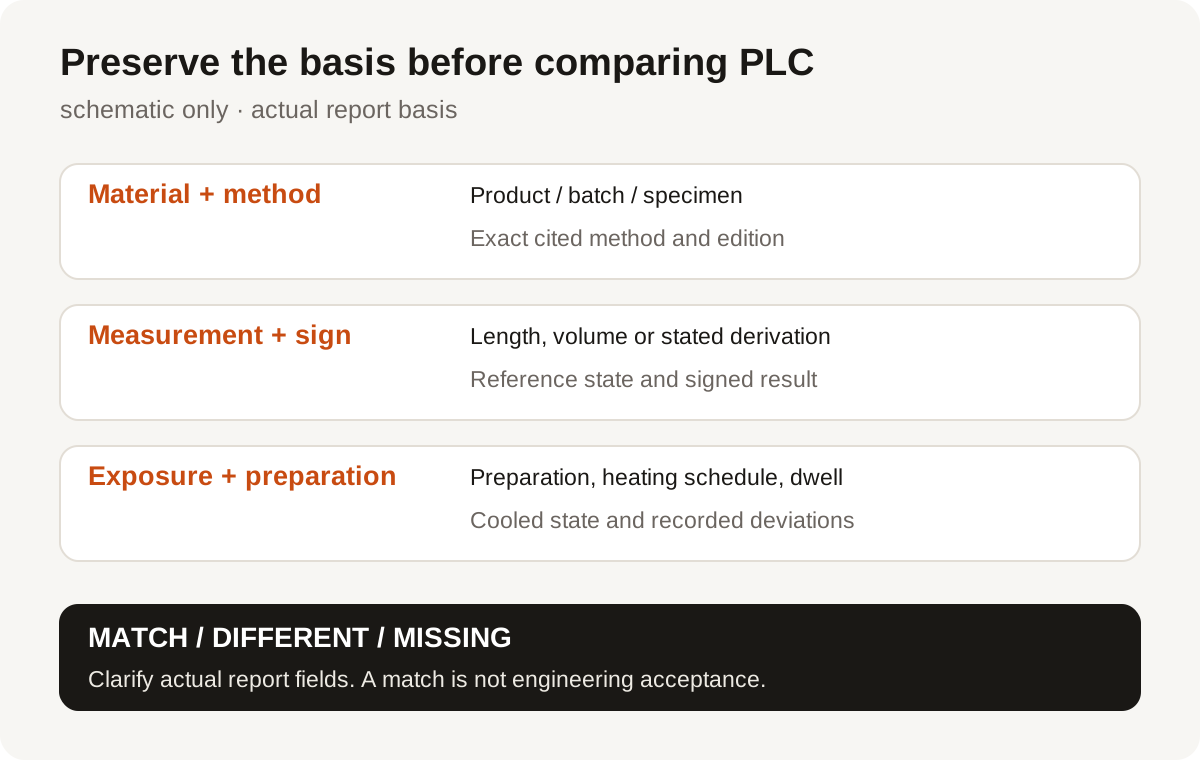
Where the basis matches, retain the result and its context together. Where it differs, state the difference before discussing the percentages. Where it is missing, request the missing field. A “match” in this worksheet means a documented comparison basis, not engineering acceptance or proof that the products are equivalent.
When preparing an inquiry from the high alumina brick product information, attach the report or identify exactly what evidence is missing. Include the application, component, material description, shapes and quantities, then ask whether comparable reheat evidence is available on the required basis. This is a product inquiry route; it does not promise that Firebrics performs a particular test, possesses a particular report, or guarantees dimensional performance.
References & Further Reading:
- ASTM C113-14(2025): public scope and significance — the official page displayed this designation when retrieved. Only its public scope and significance text was read; the complete controlled method and compliance requirements were not reviewed.
- Orton refractory testing services — laboratory descriptions distinguish C113, C210 and C179 method families. Listed specimen details, durations and service conditions are not used here as universal requirements.
- IS 1528 Part 6:2010, historical archival text — historical OCR, sections 4.1, 5, 16 and 17. Current BIS status and amendments were not verified. Used for bounded definition and measurement/reporting context, not as a current procedure or universal conversion rule.
- Dysen refractory terminology, entry 096 — secondary commercial glossary supporting the residual-after-cooling meaning; not a controlled method or Firebrics product source.
Request a Quote
Prepare your application and component details, material and batch identification, shapes and quantities, and the actual reheat report or missing-field list. Preserve its cited method and edition, measurement basis, sign, preparation, temperature schedule, dwell, and observations when asking for clarification.
Request a Quote with this documented product inquiry. Test availability, report comparability, acceptance criteria and engineering suitability require confirmation on their actual basis.