Refractory Brick Thermal Expansion: How to Read the Heating and Cooling Curves
Jason Gong
Founder & Sales Director · 10+ Years in Refractory
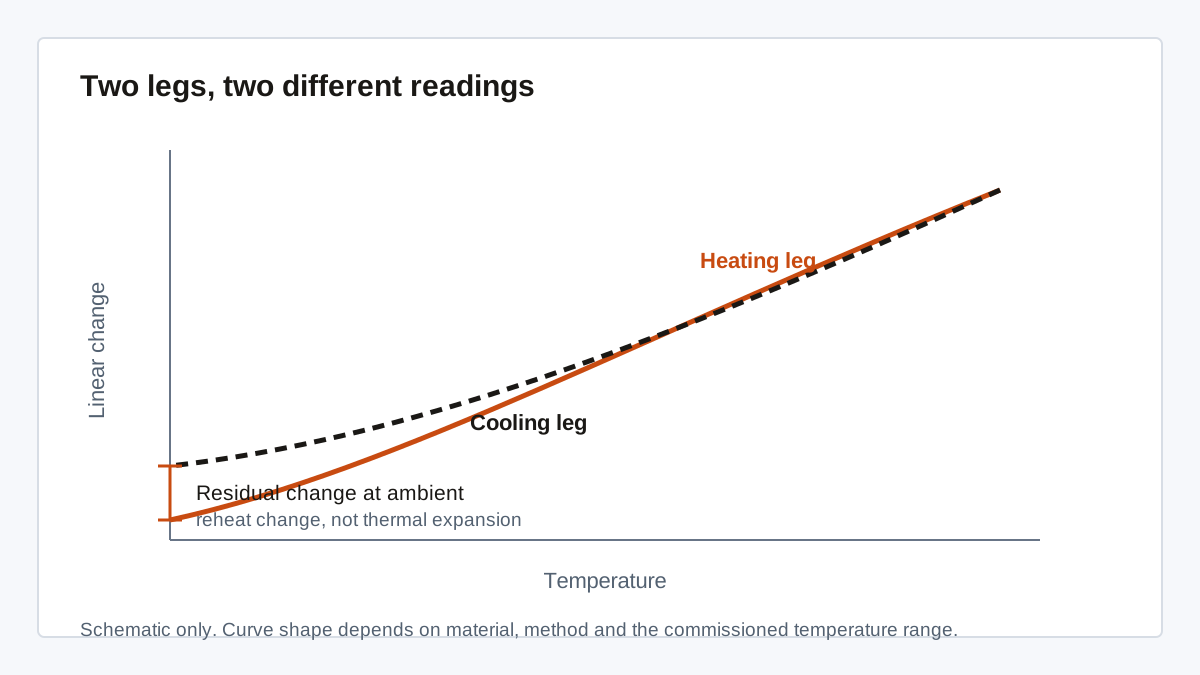
A thermal expansion figure on a data sheet is one number standing in for a curve with two legs. Before it means anything, three things must be known: whether it describes reversible movement or permanent change, whether it was measured under a sustained load, and over what temperature range it was recorded. A figure that arrives without its method, load and range cannot be compared with another supplier's figure at all.
Decision rule: compare measurement conditions before comparing numbers. If the method, applied load and commissioned temperature range do not match between two datasets, the difference between their coefficients cannot be attributed to the material.
The two legs of the curve are not the same measurement
Heat a brick and it grows; cool it and it shrinks back. If the two legs of that curve lie on top of each other, the movement is reversible, and that is thermal expansion in the strict sense. If the brick returns to a different length than it started at, part of what happened was not expansion at all — it was a permanent change in the material.
The offset that remains at ambient is that residual part, and reporting only a single coefficient hides whether it exists at all. That permanent part has its own measurement. ASTM C113 reheat change heats three bricks on a specified schedule and reports the percent linear change. Note what is being reported: the change that remains after the schedule, not the dimension the brick held while it was hot. A reheat change result and an expansion coefficient answer different questions, and a data sheet offering only one of them has not told you about the other.
Repeatability is part of the reading too. In the National Bureau of Standards measurements of brick expansion — a −10 to +40 °C study of clay building brick — each brick was put through two cooling and heating cycles, producing four expansion values whose average was taken as the test result. One pass over one specimen is not a curve; it is a single observation of a material whose first heating may not resemble its second.
What the method decides before the number means anything
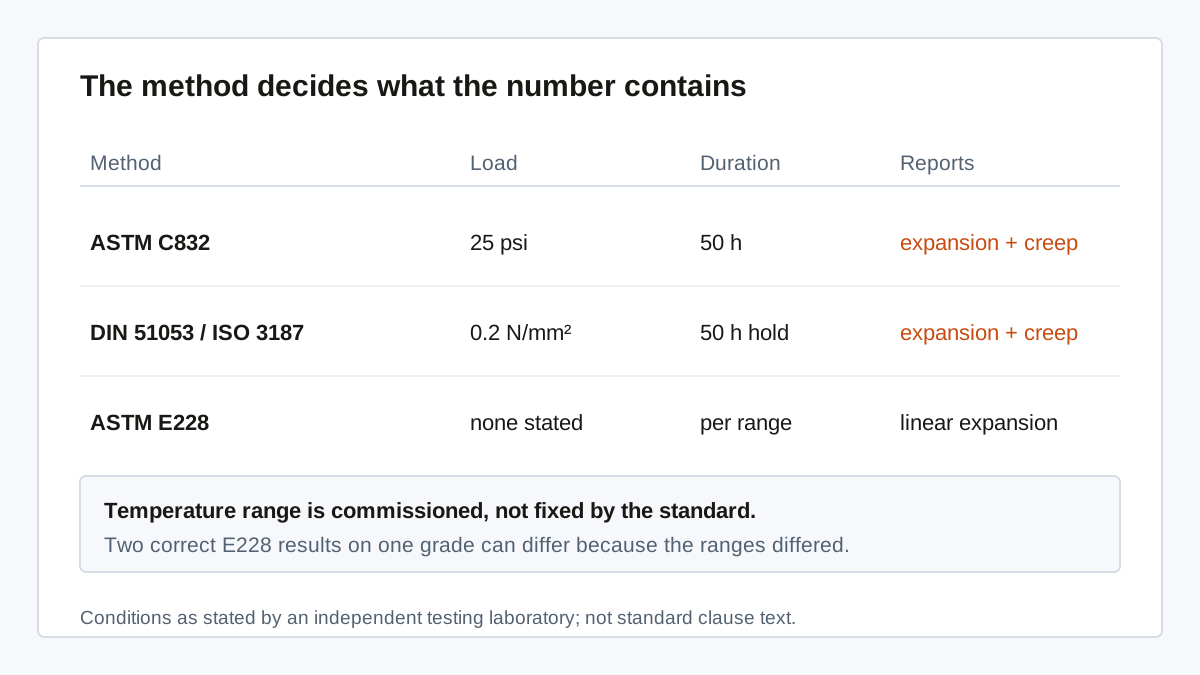
Three method choices determine what a published expansion number can and cannot be compared with.
Was a load applied? ASTM C832 determines thermal expansion and creep of refractories under load: a 25 psi compressive stress held for 50 hours, with other stresses up to 100 psi specifiable, and percent linear change recorded continuously through heat-up and the creep period. The result is a faithful picture of a loaded lining member, but expansion and creep are travelling together inside it. The European equivalent makes the same coupling explicit: DIN 51053 and ISO 3187 creep or refractoriness-under-load testing uses one 50 mm diameter by 50 mm high cylindrical specimen per firing, under standard conditions of 0.2 N/mm² (29 psi) with a 50 hour hold, recording percent linear change continuously during heat-up and the creep period.
Or was it measured unloaded? ASTM E228 covers linear thermal expansion of rigid solid materials using push-rod dilatometers, determining change in length against a temperature range specified by the customer, from which the expansion and its coefficients are calculated. No sustained load, so no creep contribution — but also no information about how the material behaves with a wall standing on it.
Over what range? The phrase worth noticing in E228 is specified by the customer. The temperature range is not a property of the standard; it is a commissioning decision. Two laboratories can both run E228 correctly, on the same grade, and return coefficients that are not comparable, because one was asked for 20–500 °C and the other for 20–1200 °C.
A worked example of a figure that does not transfer
A concrete case shows how far a correct number can sit from a usable one.
NBS Research Paper RP1414, Thermal Expansion of Clay Building Bricks (1941), measured 139 bricks over −10 to +40 °C, including nine fire-clay samples, and reported average coefficients of 6.0 millionths per °C for clay brick, 6.1 for shale brick and 3.9 for fire-clay brick. The work is careful, the fire-clay figure is real, and it is useless for a furnace lining — the measurement range is roughly ambient, because the study was about masonry walls in buildings.
This is not a hypothetical trap. In the Google US desktop result set recorded on 14 October 2026 for thermal expansion of refractory bricks, RP1414 ranked third, four of the ten results were supplier or manufacturer pages, and no page in the set stated a measurement method and temperature basis alongside a quoted coefficient. A reader comparing data sheets can reach an authoritative, government-published fire-clay coefficient in two clicks with no indication that it stops at 40 °C.
One more finding from the same paper is worth carrying: RP1414 observed no relation between the thermal expansion of the bricks and their other measured physical properties — in that study, compressive strength, modulus of rupture and water absorption. Expansion did not track any of them, so it has to be measured, on the material in question, over the range in question, rather than inferred from the rest of the data sheet.
Turning a curve into expansion-allowance inputs
An expansion allowance needs four inputs, and a single coefficient supplies only part of one of them.
- Which leg applies. A lining held hot takes the heating leg; one that cycles needs both legs and the difference between them.
- The temperature span the component actually sees, not the span the test was run over. Where those differ, the published coefficient does not cover the application.
- The dimension and direction the movement acts along — the run of wall, not the single brick.
- Whether the figure includes creep. A loaded-method result already contains time-dependent deformation, so using it as a pure expansion input double-counts movement the lining will also develop under load.
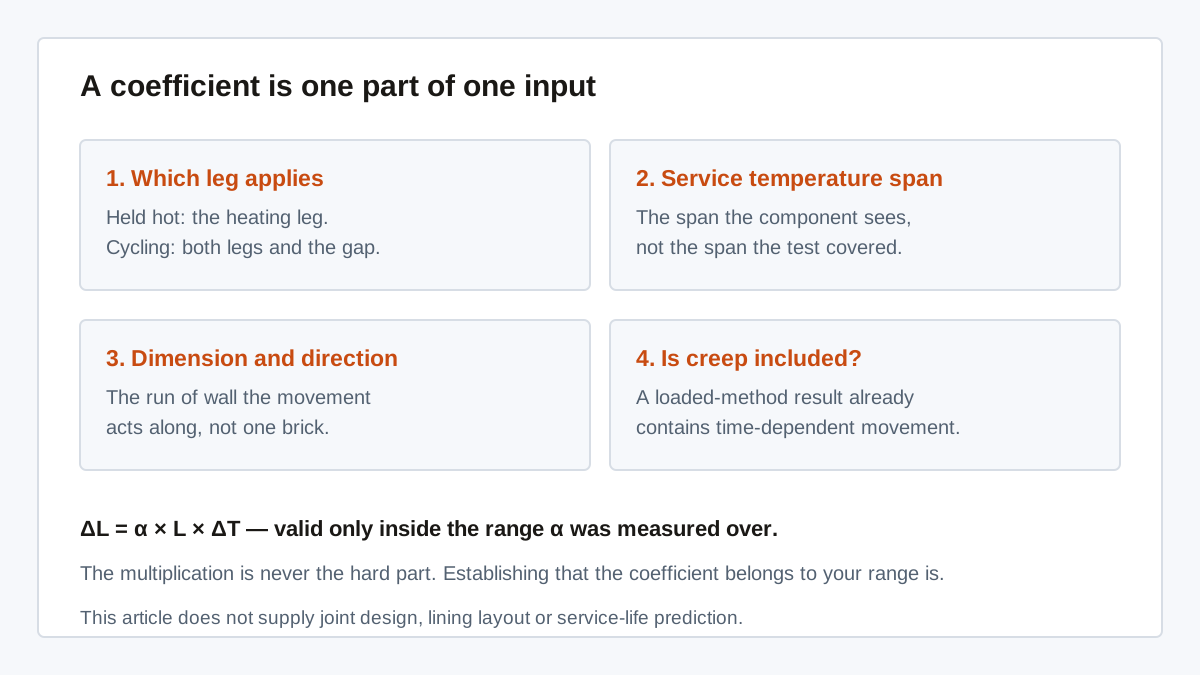
The arithmetic itself is unremarkable: change in length equals the coefficient times the original length times the temperature change. Used strictly inside its own validity, the RP1414 fire-clay average of 3.9 millionths per °C over a 50 K rise gives about 0.045 mm on a 230 mm brick — a figure correct for −10 to +40 °C that tells you nothing about the same brick at 1000 °C. The multiplication is never the hard part. Establishing that the coefficient belongs to your range is.
For the separate question of how much heat crosses the wall once it is built, see thermal conductivity, which owns heat transfer rather than dimensional change.
What to request from a supplier
Six items turn an expansion claim into a comparable dataset:
- The test method and its designation — C832, E228, ISO 3187 or another, named explicitly.
- The applied load, or a statement that none was applied.
- The temperature range the measurement covers, as commissioned.
- The curve, not only the coefficient — both legs, so reversibility is visible.
- The specimen description: size, orientation and how it was prepared.
- Reheat change reported separately, so permanent movement is not hidden inside an expansion number.
If two suppliers return all six and the entries match, the figures can be compared. If any of the six is missing from either, the comparison is not available yet — and that, rather than the number itself, is the finding worth acting on. Expansion data is one of the fields we are asked for on high alumina brick enquiries.
References & Further Reading:
- C. W. Ross, Thermal Expansion of Clay Building Bricks, NBS Research Paper RP1414, Journal of Research of the National Bureau of Standards, Vol. 27 (1941) — nvlpubs.nist.gov. Measured over −10 to +40 °C on clay building brick; cited here for its fire-clay figure and its stated range, not as a hot-face value.
- Orton Ceramic, Refractory Testing method catalogue — ortonceramic.com. Cited for the stated conditions of ASTM C832, C113, C1171 and DIN 51053 / ISO 3187; it is a laboratory service catalogue, not the standard text.
- Touchstone Research Laboratory, ASTM E228 push-rod dilatometer testing — trl.com. Cited for the scope of E228 and for the customer-specified temperature range.
Scope limits: this article interprets published expansion data. It does not supply joint design, lining layout, crack-prevention advice or service-life prediction, and it makes no claim about the test capability of any supplier.
Requesting expansion data for a specific grade?
Measurement basis means the test method, the applied load, the commissioned temperature range and the specimen description.