Forge Fire Bricks: Types, Grades & Layout Guide
Jason Gong
Founder & Sales Director · 10+ Years in Refractory
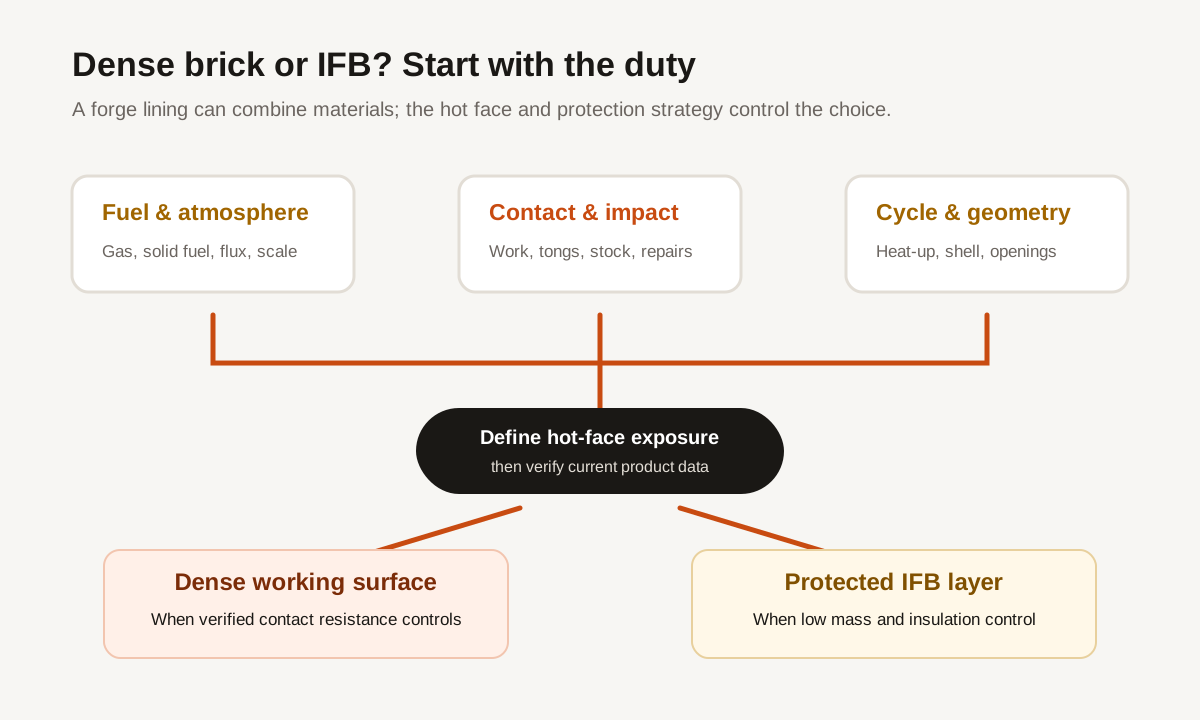
Choose fire bricks for a forge from four inputs: fuel and atmosphere, the design hot-face temperature, mechanical contact, and the exact brick data sheet. Insulating firebrick (IFB) is useful where low heat storage matters and the lining is protected; dense refractory brick is useful where scale, stock, tools or fuel contact the surface. “K26” or a headline temperature alone does not validate a forge lining or burner design.
What fire bricks do in a forge
A blacksmith's forge is a high-temperature chamber. The fire brick lining does three things:
- Limits heat flow to the shell — low-conductivity layers reduce heat transfer, but the complete lining thickness, joints, openings and steel shell still need a thermal review.
- Provides a usable hot face — the exposed layer must tolerate the atmosphere, flame pattern, flux or scale, and any contact expected in that zone.
- Survives the operating cycle — product classification temperature is only one input; shrinkage, thermal cycling, strength and installation details also matter.
Hard brick vs insulating fire brick (IFB)
Two fundamentally different types of fire brick exist. Understanding which to use where is the central decision in forge brick selection.
Dense refractory brick has greater mass and mechanical strength than IFB. It is commonly considered for floors or contact zones, subject to its chemistry, duty and the actual forge design.
Insulating firebrick (IFB) uses a porous structure for low heat storage and low thermal conductivity. It is much less resistant to impact than dense brick and therefore needs protection from stock, tools, fuel and falling scale. Morgan's K-series product data illustrates the difference: its K26 IFB has a classification temperature of 1,430°C but a cold crushing strength of only 1.3 MPa, and the manufacturer says suitability still requires application review.
A useful screening pattern: protect low-mass insulation in non-contact walls or roof zones, and evaluate a stronger hot-face material wherever abrasion or impact occurs. This is a starting layout concept, not a universal build specification.
Define the duty before selecting a grade
| Input | Question to answer | Evidence | Why it changes selection |
|---|---|---|---|
| Process and steel | Which operations and alloys are planned? | Process sheet or qualified blacksmith guidance | Workpiece temperature is not automatically the lining hot-face temperature |
| Fuel and atmosphere | Gas, solid fuel, oxidizing, reducing or flux-bearing? | Burner/fuel design and operating practice | Chemistry and local flame exposure change |
| Temperature | What are the normal and upset hot-face values? | Instrumented test or engineering calculation | Classification temperature is only a screening value |
| Mechanical contact | Where do stock, scale, tools or fuel touch? | Zone drawing | IFB may need a durable sacrificial or dense surface |
| Cycle | How fast and how often does the forge heat and cool? | Operating schedule | Shrinkage and joint movement become selection inputs |
The FAO blacksmithing guide gives approximate steel-color ranges for different operations, but those values describe the workpiece and vary by steel and observation conditions. They should not be copied directly into an IFB grade decision.
Read K-grade data as a screening tool
| Grade | Classification temp | Cold crushing strength | Selection note |
|---|---|---|---|
| K23 | 1,315°C | 1.0 MPa | Compare shrinkage and conductivity at the relevant mean temperature |
| K26 | 1,430°C | 1.3 MPa | Do not equate classification temperature with continuous allowable hot-face temperature |
| Other IFB | Manufacturer-specific | Manufacturer-specific | Request the same property set and application confirmation |
The correct comparison includes classification temperature, permanent linear change or shrinkage, strength, density, conductivity at temperature, chemistry, size tolerance and supplier restrictions. Ask the supplier to confirm the proposed hot-face duty instead of selecting by grade name alone.
Calculate brick quantity from the chamber geometry
| Input | Record | Why it matters | Common error |
|---|---|---|---|
| Internal chamber | Length, width, height and openings | Defines net lined surface area | Ordering from burner count |
| Layer arrangement | Hot face, insulation, backup and shell clearance | Different zones can use different materials | Counting all surfaces as one brick type |
| Actual unit size | Supplier dimensions and tolerances | Nominal imperial and metric units differ | Assuming every brick is 9 × 4.5 × 2.5 inches |
| Cuts and spares | Bond, penetrations and replaceable wear zones | Drives realistic waste and maintenance stock | Applying one fixed waste percentage to every layout |
For each zone, divide the net lined area by the installed face area of the chosen unit, then adjust for bond, penetrations, cut geometry and planned spares. Keep dense contact-zone units and IFB units as separate line items. A fixed “8–12 bricks per burner” rule cannot account for chamber proportions or lining thickness.
Hard brick vs soft IFB — full comparison
| Factor | Dense fire brick (medium-duty) | Insulating IFB (K26) |
|---|---|---|
| Primary function | Durable refractory hot face | Low heat storage and insulation |
| Mechanical contact | Usually more tolerant; verify strength and abrasion data | Protect from stock, tools, fuel and scale |
| Heat-up behavior | More stored heat for the same geometry | Less stored heat for the same geometry |
| Temperature evidence | Duty/classification and product properties | Classification, shrinkage and conductivity data |
| Zone use | Evaluate floors and wear surfaces | Evaluate protected walls, roof or backup zones |
| Purchase comparison | Chemistry, dimensions, strength and lot data | Grade, shrinkage, density, conductivity and lot data |
Turn the material decision into a reviewed layout
A conceptual zone layout can separate a durable contact surface from protected insulation, but it is not a burner or gas-train design. Combustion, ventilation, flashback, carbon monoxide, shell temperature and fuel-system safety require qualified design and applicable local rules.
Contact surface: identify where stock, scale and tools land. Compare dense or sacrificial refractory options for that measured duty.
Protected walls and roof: evaluate IFB only where its low strength is acceptable and the design keeps it away from direct impact.
Openings and penetrations: treat doors and burner penetrations as local heat-loss and erosion zones. They need their own detail rather than leftover cut pieces.
Shell and backup: calculate shell clearance and surface temperature using the full lining system. Do not assume a layer of IFB alone makes the outer shell safe to touch or place near combustibles.
Whether joints are dry, mortared or mechanically retained depends on the geometry, gas tightness, movement and selected product. Follow the lining and mortar suppliers' instructions; a dry-stacked hobby example is not a universal construction rule.
Why forge fire brick fails
- Selecting by a single temperature number — ignores shrinkage, atmosphere, strength and local flame exposure.
- Exposing IFB to contact — stock, tools, fuel or scale can damage a low-strength insulating surface.
- Buying by retail label — “firebrick” does not identify a duty, standard, chemistry or continuous-use limit.
- Copying a loose-brick layout without a safety review — lining material does not validate the burner, gas train, ventilation, carbon-monoxide control or shell temperature.
- Ignoring expansion and retention — the supplier and designer must define clearances, joints and anchors for the selected geometry.
Need forge fire brick in quantity?
Further reading
- Morgan K Insulating Firebrick Series data sheet
- FAO blacksmithing operations and heat-color guidance
- Ceramic Kiln Refractory Solutions
- How to Choose Insulating Fire Bricks