Apparent Porosity and Bulk Density: Read Refractory Test Data on the Same Basis
Jason Gong
Founder & Sales Director · 10+ Years in Refractory
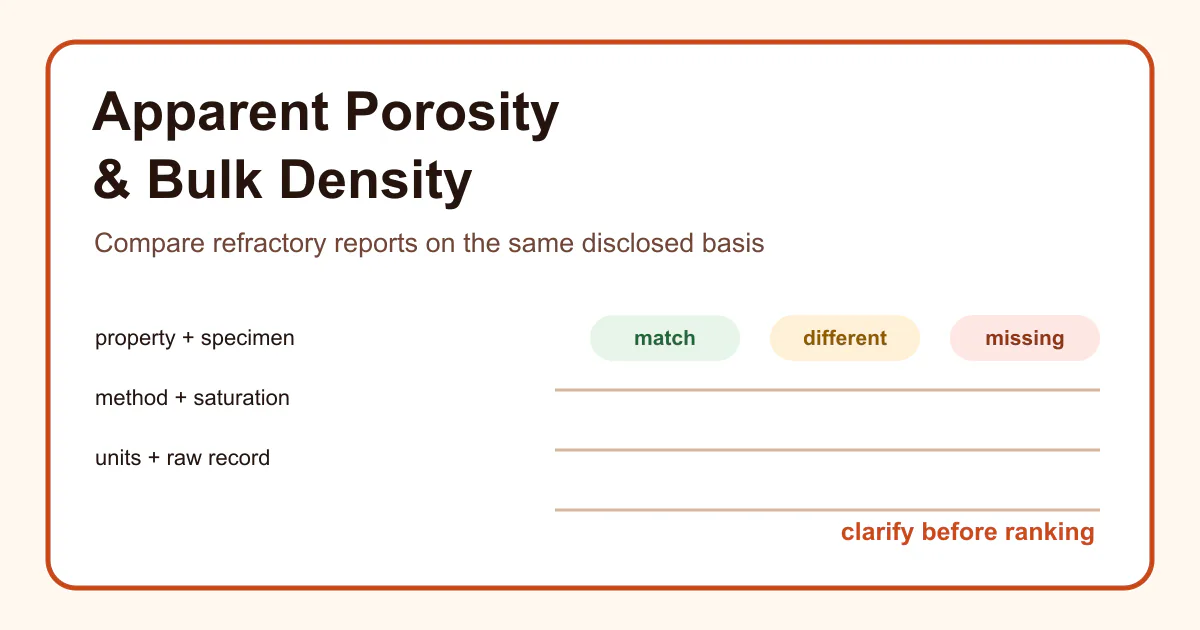
Apparent porosity describes pore space that is accessible to the test liquid; it is not total pore volume. Bulk density is dry mass divided by bulk volume. Before comparing two refractory reports, confirm the property definition, product and specimen condition, method and edition, saturation route and liquid, preparation, units, results, and laboratory calculation basis. C20, C830, and C134 do not provide one interchangeable density procedure. If a field differs or is missing, clarify it before ranking the values.
Separate apparent porosity from total pore volume
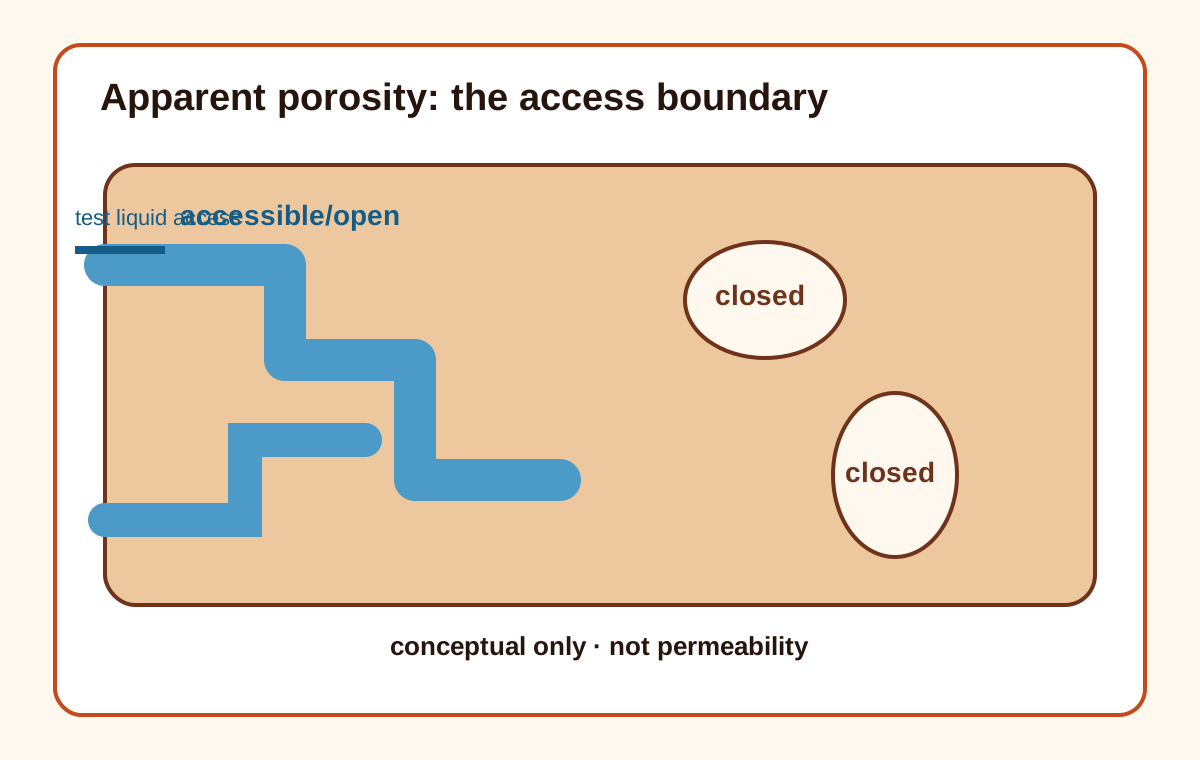
Apparent porosity concerns open pores connected to the specimen surface, or otherwise accessible to the liquid used by the test. A closed pore that the liquid cannot reach does not belong to that accessible volume. Total pore volume is therefore a different concept: it can include both open and closed pores.
This boundary matters when reading a data sheet. A reported apparent-porosity value is tied to what the stated method and liquid could access under the stated specimen conditions. It is not a direct map of every void inside the refractory, and it does not by itself show how easily a gas, slag, or another fluid will move through the material.
Request the laboratory raw mass records without inventing symbols
A report may provide only final apparent-porosity, absorption, or bulk-density values. When two reports need a controlled comparison, request the underlying laboratory record or calculation sheet as well as the result. Ask for the specimen identity and condition, the method and edition, the saturation route, the liquid, and the preparation and blotting basis used by that laboratory.
Where the laboratory’s method uses them, request its recorded dry, saturated, and suspended measurements. Keep the laboratory’s own names, units, and calculation convention attached to those entries. Do not assign familiar letters to the measurements, reconstruct a formula from an incomplete certificate, or assume that every cited method uses all three fields in the same way.
The purpose of this request is traceability. It lets the reviewer see whether the reports begin from comparable observations and whether a missing or inconsistent base measurement could affect more than one reported property.
Read bulk density as dry mass divided by bulk volume
Bulk density is the ratio of a specimen’s dry mass to its bulk volume. “Bulk volume” refers to the specimen’s overall volume on the stated test basis, so the report must make clear how that volume was established. The definition alone does not make values interchangeable when the methods, specimen conditions, or volume determinations differ.
Preserve both the mass and volume units shown by the laboratory, together with the final density unit. A unit conversion can align equivalent units. It cannot correct a different specimen basis, saturation route, liquid, preparation, or volume method.
Distinguish boiling-water and vacuum-pressure saturation
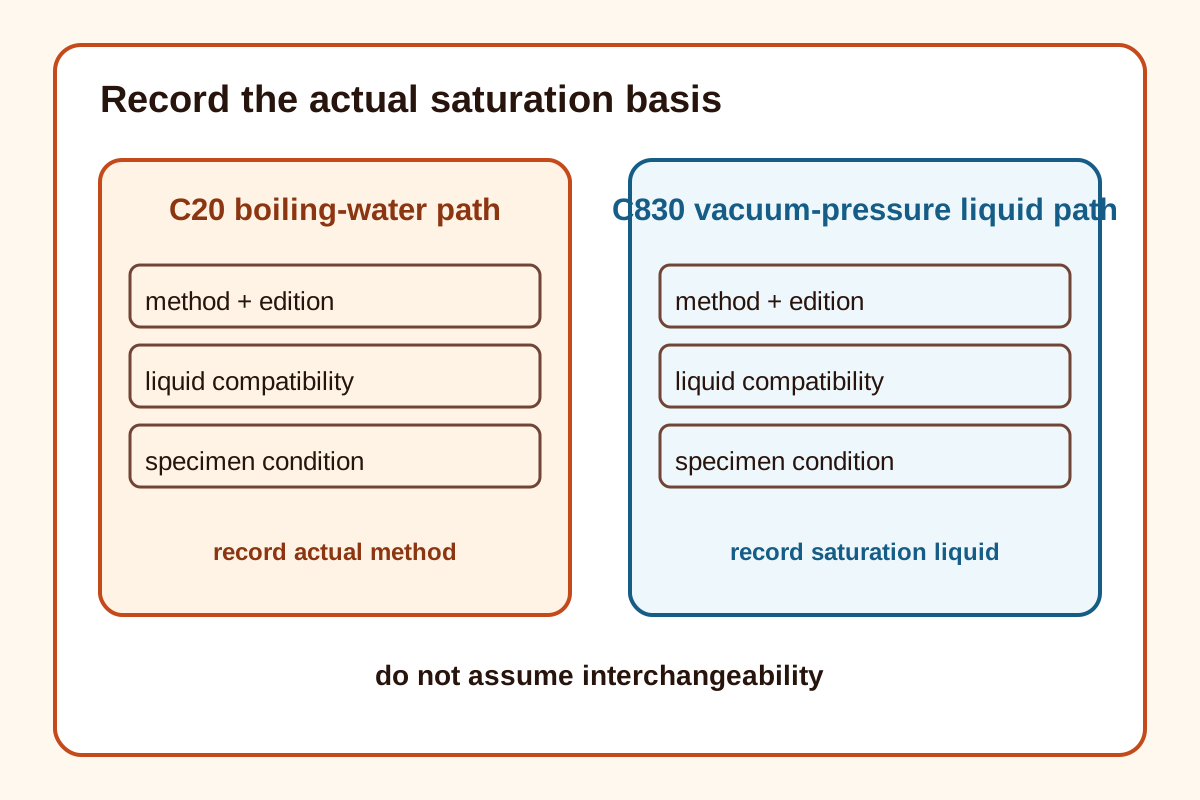
ASTM C20-00(2022) covers burned refractory brick and shapes using a boiling-water basis. Its public scope assumes that the specimen is not attacked by water, that open pores are fully impregnated, and that saturated specimens are blotted consistently. Those assumptions belong to the result’s comparison basis.
ASTM C830-00(2023) uses vacuum-pressure liquid impregnation. Its public scope makes the impregnation liquid and its density or specific gravity part of the basis, particularly when water compatibility is a concern. A report labelled C830 should therefore identify the liquid and the applicable correction or laboratory calculation basis rather than leaving “vacuum tested” as the entire method description.
ASTM C134-95(2023) covers the size, dimensional measurements, and bulk density of rectangular dense and insulating refractory brick. Its public scope points to other methods when a more precise or different procedure is required. A C134 field bulk-density result, a C20 boiling-water result, and a C830 vacuum-pressure result should not be treated as interchangeable merely because each report includes the words “bulk density.”
Check liquid and material compatibility
The saturation liquid is evidence, not a background detail. For a C20 comparison, confirm that the product and specimen meet the method’s water-compatibility assumption. For a C830 comparison, record the liquid used and the liquid-density or specific-gravity basis stated by the laboratory.
Do not choose a saturation route from a broad product label alone. If a product may react with water, hydrate, contain carbon, or present another compatibility concern, ask the laboratory and responsible technical reviewer to identify the applicable method, liquid, specimen preparation, and any deviation. The public scopes do not support one universal method choice for every such product.
Blotting and surface-liquid handling also belong in the record when they apply. Consistency matters because the same base observations can feed multiple reported properties. If one report describes its preparation and the other does not, mark the second report missing rather than assuming that both laboratories followed the same basis.
Compare reports on the same disclosed basis
The C20 and C830 public scopes warn that errors in shared base data can affect multiple reported properties. They also call for judicious comparison between like products, with relevant method or product differences disclosed. Start with the basis, then read the values.
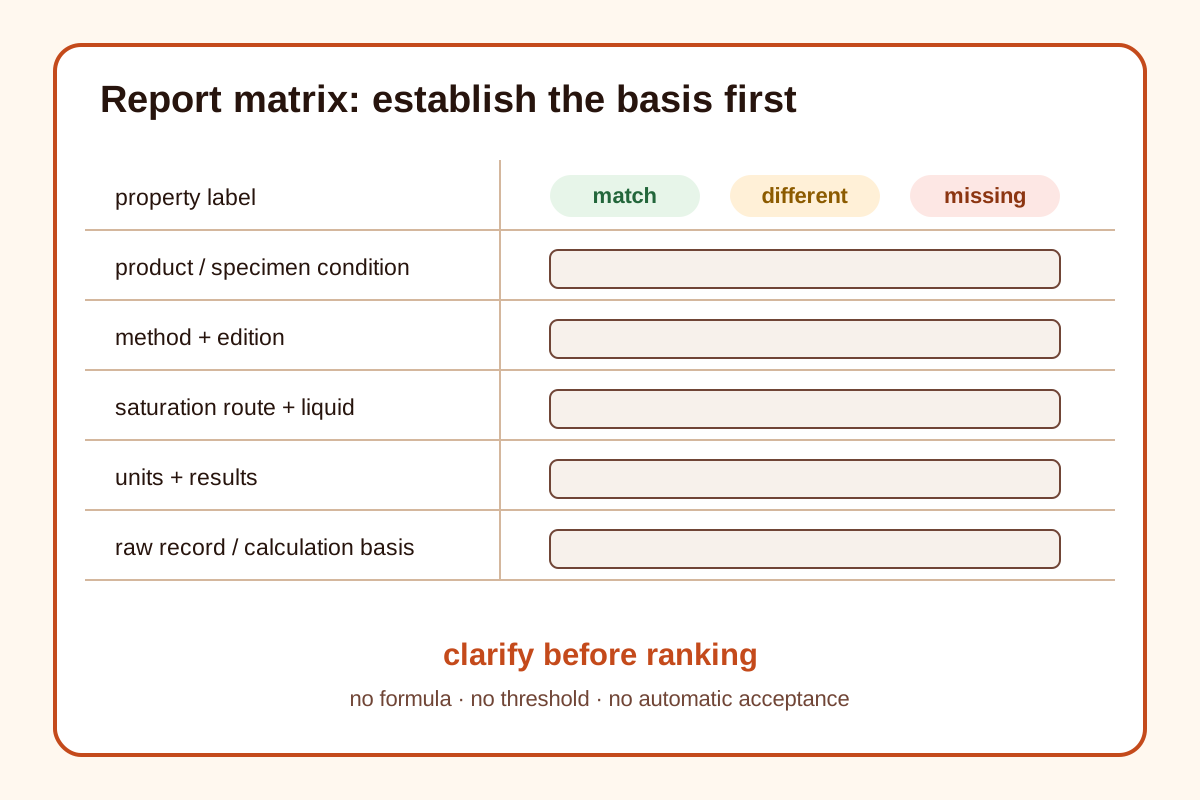
| Comparison field | Report A | Report B | Status: match / different / missing | Clarification or evidence needed |
|---|---|---|---|---|
| Property label and definition | ||||
| Product, batch, and specimen identity | ||||
| Specimen shape, dimensions, and condition | ||||
| Method and edition | ||||
| Saturation route | ||||
| Saturation liquid and liquid-property basis | ||||
| Preparation, impregnation, and blotting basis | ||||
| Dry, saturated, and suspended records, when used | ||||
| Bulk-volume determination | ||||
| Units and conversions | ||||
| Individual and reported results | ||||
| Laboratory calculation sheet or raw-record reference | ||||
| Declared deviations and limitations | ||||
| Project-specific review criterion |
“Different” does not prove that either result is wrong. It means the two values have not yet demonstrated the same test basis. “Missing” is an evidence request, not permission to fill the gap from another report. This worksheet is a buyer comparison tool; it is not a quotation of mandatory report clauses for every method.
Only after the basis is compatible should the reviewer compare the reported results. Keep individual measurements, summaries, units, declared deviations, and project criterion together. Do not create a universal cutoff or automatic ranking from this worksheet.
Keep porosity separate from permeability, k-value and product selection
Apparent porosity alone does not establish permeability. Accessible pore volume does not describe every connection, passage shape, or flow condition needed to make a permeability conclusion. It also does not establish corrosion or slag resistance, mechanical strength, suitability, or service life.
Porosity and bulk density can appear alongside thermal conductivity, but one does not supply a universal k-value for the other. Use the refractory brick thermal-conductivity report guide when the decision concerns temperature-conditioned conductivity data and its test basis. Do not rank k-values, select dense versus insulating products, or choose a furnace application from porosity alone.
Acceptance remains a project decision. The applicable specification, purchase documents, sampling plan, laboratory record, and responsible technical review must establish the criterion. This article supplies no numerical threshold or performance guarantee.
Build a bounded porosity and density evidence request
Turn every missing worksheet field into a specific request. Include:
- application and component context;
- proposed product, batch, and specimen identity;
- apparent-porosity and bulk-density values being reviewed;
- required method and edition, when the project specifies them;
- specimen shape, dimensions, preparation, and condition;
- saturation route and liquid, including the laboratory’s liquid-property basis;
- impregnation, blotting, and bulk-volume basis;
- reported units, individual results, and summary basis;
- the laboratory raw record or calculation sheet, including dry, saturated, and suspended measurements when its method uses them;
- declared deviations, project-specific review criterion, required shapes, and quantities.
The high-alumina brick inquiry page is the commercial route for this documented request. The page does not prove that Firebrics performs the tests, does not establish a porosity or density threshold, and does not turn either property into a product-suitability guarantee.
References & Further Reading:
- ASTM C20-00(2022) official scope — current public scope for boiling-water testing of burned refractory brick and shapes; the controlled standard governs the full procedure, calculations, and report requirements.
- ASTM C830-00(2023) official scope — current public scope for vacuum-pressure liquid impregnation; the controlled standard governs the full procedure and calculation convention.
- ASTM C134-95(2023) official scope — current public scope for size, dimensional measurements, and bulk density of rectangular dense and insulating refractory brick.
- Lucideon refractory density and porosity method summary — supports the dry-mass and bulk-volume definition used here; its listed BS method references are historical and are not presented as current editions.